Article in the Lawrence Journal - World about Give Take Give
by Sara Shepherd February 10, 2013
One man's trash: Artist’s project highlights unusual gift economy in downtown alley
Monday, February 11, 2013

Friday, February 8, 2013
Inventory #11
Thursday, February 7th
3:00 pm
45˚ Sunny
coat hangers some of them nice wood ones from The Edgewater in Madison, Wisconsin
a couple of raw yams
straw hat
two pairs of flip-flops
two fresh banana peels
small colored bible quote / prayer cards
men's Footjoy golf shoes
many books including:
"The House on Hope Street" by Danielle Steele
"Introduction to Economic Science" by George Soule
"Gather Together in My Name" by Maya Angelou
"Discipline and the Disruptive Child"
Kansas City Scouts tote bag
blue sidewalk chalk
one ping-pong ball
"They Grow Like Weeds" posters by Anne Geddes
Pioneer Investments white baseball cap
handwritten cardboard sign that read "Homeless & Pregnant Cold, Hungry + Very Tired Please Help! Thanks"
close to a full set of 1958 World Book encyclopedias
Bible Fun coloring book and mazes
dried dandelions carefully wrapped and packaged in plastic bags
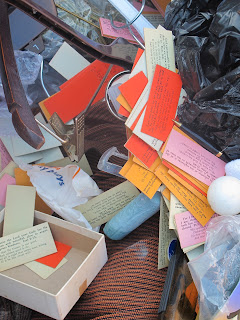
1991-92 color proofs for cover of Explore Magazine from the University of Kansas

3:00 pm
45˚ Sunny
coat hangers some of them nice wood ones from The Edgewater in Madison, Wisconsin
a couple of raw yams
straw hat
two pairs of flip-flops
two fresh banana peels
small colored bible quote / prayer cards

men's Footjoy golf shoes
many books including:
"The House on Hope Street" by Danielle Steele
"Introduction to Economic Science" by George Soule
"Gather Together in My Name" by Maya Angelou
"Discipline and the Disruptive Child"
Kansas City Scouts tote bag
blue sidewalk chalk
one ping-pong ball
"They Grow Like Weeds" posters by Anne Geddes
Pioneer Investments white baseball cap
handwritten cardboard sign that read "Homeless & Pregnant Cold, Hungry + Very Tired Please Help! Thanks"
close to a full set of 1958 World Book encyclopedias
Bible Fun coloring book and mazes
dried dandelions carefully wrapped and packaged in plastic bags
1991-92 color proofs for cover of Explore Magazine from the University of Kansas

Sunday, January 27, 2013
Introduction to Give Take Give
They say the National debt is $14,000,000,000,000.
The average
family credit card debt in the U.S. is about $16,000.
The average
student loan debt is $25,000.
We’re told
that this debt will destroy our country, our families, and our potential.
Maybe…but I
believe a certain kind of debt could be the thing that holds us together.
I have
other debts.
To my
family, I have a debt I can never repay.
To my
teachers, I owe a debt of gratitude.
I am in
debt to my peers, and past artists who have inspired me.
I am
indebted to my friends and neighbors who never ask for the balance of what I
owe them.
Looking at
the ledger of my life, the accounts are never quite square. From some I
receive, to others I give. We are indebted to each other and the cycle never
seems to end.
In my
neighborhood there is an annual event called the Free Sale where there is no
trading and no money changes hands. I was reminded of the Free Sale a while
back when I was introduced to the small gift economy that had developed out of
a city dumpster in the alley near my apartment. Like the Free Sale, people were
leaving what they wanted to give and taking what they needed. But unlike the
well organized Free Sale, the rules of the dumpster were unspoken.
I am a
participant in this exchange, and have documented its ever-changing contents.
It is a wonder of mixed up treasure and a locus for neighborhood news. Its
layerings of are like a living archeological site continually being excavated
and reburied. An uncurated space, it is organized only by those who go through
it looking for things, those who add to its bounty, and the sanitation workers
who empty it once a week.
I always
thought I would make something of my observations, but have hesitated until
now. I held off because I worried that drawing too much attention to this place
might overwhelm it. Now, I take that risk. Plans for a hotel to go in the space
across from the dumpster have been filed with the city. Although It’s not clear
how use of the dumpster would change if the hotel is built, the alley would
become a far cry from the pedestrian corridor and improvised gathering place it
is now.
Through
photographs, interviews with participants, a regular inventory, and modest publication
given away for free, this project will explore the economy of and stories
connected to the dumpster. By shedding light on an alternate economy hidden in
plain sight, I hope that others will be inspired to reflect on how gifts of
labor, teaching and time, as well as things, can help bind us together in a
connected circuit of good will. In other words, how this asymmetrical cycle of
giving and taking engenders new relationships, creating a network of mutual indebtedness.
Wednesday, January 9, 2013
Inventory #10
3:00pm 35˚ sunny
(I was met at the dumpster by Journal-World reporter Sara Shepherd who interviewed me about the project while Richard Gwin took photos)
 | ||
| View of the dumpster through fenced off area that will soon become a five-story Marriott hotel |
pink and blue jack-o-lantern trick or treat baskets
men's and women's sandals
assortment of women's shoes
cds painted to look like records
poster of irises mounted on foam core
glazed ceramic coil pot with the word 'Bath' embossed into its base
faux wicker wall decoration accessorized with plastic ivy
glass vases
tote bags
pink flower decorated tray table with stand
toy '911' police truck
wicker fruit basket
32 oz refillable drink cup
plastic cupcake
green denim pants
children's book "One Grain of Sand"
handmade watercolor Mother's Day card from 2000
lots more down below

Tuesday, January 8, 2013
Take a penny, leave a penny
Coffee and a bagel, $4.97. I handed over a five dollar bill, got three cents change and put the coins in the little ceramic dish next to the cash register - a small gift for a future patron who comes up a few pennies short. The next time it may be me who needs the help, and without a second thought I'll reach into that same dish.
In a very unscientific study of coffee shops along Massachusetts St.,
I
found that all five of the locally owned ones I visited maintained penny
dishes, while the two corporate chains I checked did not.
It's a modest convenience to help make change and keep the wheels of commerce turning. It's also a form of gift exchange that operates right next to the cash economy. As pennies lose buying power (Canada minted its last one cent piece in 2011, and many in the U.S. have called for the End to the penny here), they are easier and easier to part with. But imagine, if there is, let's say, just $20 in change that circulates through these exchanges in Lawrence in a week, that would mean $1,040 in a year, and literally millions circulating freely across the country, from those with more than they need to those who don't have quite enough.
All of us who give and or take a coin or two are participating in a kind of 'pay it forward' economy predicated on trust (there are no explicit rules for how many coins we can take) and long-term reciprocation (we can imagine that one day we will be the ones in need). This begs the question, if we can freely exchange pennies, nickels and dimes, why not quarters, and why other things like food, housing or education?
*Update*
As an answer to my question above, an old friend who lives in Nevada City, California sent the blog post below. The original source can be found here. To see more photos of the veggie cart click here.
Outside Inn Veggie Cart

 |
| Wheatfields |
It's a modest convenience to help make change and keep the wheels of commerce turning. It's also a form of gift exchange that operates right next to the cash economy. As pennies lose buying power (Canada minted its last one cent piece in 2011, and many in the U.S. have called for the End to the penny here), they are easier and easier to part with. But imagine, if there is, let's say, just $20 in change that circulates through these exchanges in Lawrence in a week, that would mean $1,040 in a year, and literally millions circulating freely across the country, from those with more than they need to those who don't have quite enough.
 |
| Henry's |
 |
| Z's |
 |
| Aimee's |
 |
| La Prima Tazza |
*Update*
As an answer to my question above, an old friend who lives in Nevada City, California sent the blog post below. The original source can be found here. To see more photos of the veggie cart click here.
Outside Inn Veggie Cart

The Outside Inn’s
veggie cart has made its 2102 season debut, for those of you who have
been wondering when it would reappear. The original antique cart didn’t
weather the winter and we’ve been trying to come up with an alternative
option to house our free neighbors vegetable baskets, so we apologize
for the delay in the opening of our free fruit and veggie stand. For
those of you unfamiliar with our cart please check out this blog post about the 2011 Neighbors Vegetables season. Lots of great pictures from last year’s bounty, click here
to see more. The Outside Inn loves watching the flow of traffic, from
the generous people sharing their extra homegrown fruits and vegetables,
to the folks who enjoy collecting a goodie or two to the Outside Inn
guests who don’t understand the concept that the cart is free, the whole
project is another reason why we love Nevada City.
Saturday, December 29, 2012
Inventory # 9
Saturday, December 29, 2012
25˚ Sunny

rubber stamps (one of a church another that said 'Save the Rainforests')
soft black play horse head without pole for riding
childs tricycle
month-long green plastic pill box
books including
"The Nancy Drew Files - Fatal Attraction" by Carolyn Keene
"The Feminine Mystique" by Betty Freidan
"Hunters and Horrors - 10 Grisly Tales"
"The Atlantic Monthly - Diamond Jubilee Issue" from 1932 (Goddard High School stamped on it)
books in Russian
"The Anatomy of Dependence" by Takeo Doi
"Marx and Engels - Basic writing about politics and philosophy"
"Patterns in Western Ciivilization"
"The Trembling Leaf" by John Colleton
"The Souls of Black Folk" by W.E.B. Dubois
Christmas wreath
red, blue, and gold round Christmas tree ornaments
tall beer glasses with Have Fun! Pat Obrien's New Orleans, Louisiana printed on them
glass vases
wicker magazine rack
many children's vhs movies including "Beauty and the Beast"
vhs of Bob Ross No. 3
belt for a hernia
Enjoy Sarajevo 1995 in Coca-Cola design with year calendar on back
many pairs of shoes
soccer ball paper weights
swiveling lounge chair

Friday, December 28, 2012
Nourishing the Body, Mind, and Sense of Wonder: Economies of good will in Lawrence
Give Take Give is
focused on the free flow of goods and the meandering current of people that run
through and eddy around the dumpster behind the Social Service League, but this
isn’t the only place to find evidence of an alternative economy in Lawrence. In
fact, when you recalibrate your notion of what an economy is supposed to look
like, to include markets that don’t assume a quid pro quo, many more instances of gift or exchange economies
become apparent. Below, are a few of my
favorites.

CJ and her husband Bill decided to make this little library after seeing a tv story about others doing the same in different parts of the country. It wasn’t such a stretch for them, since they have maintained a community library and meeting space inside their home for many years. By extending their collection and creating a branch of sorts outside, they hoped to attract the student, neighbor, delivery person, or meter reader who might not feel as comfortable knocking on their door.

Architecturally, the house shaped structure invites the curious by differentiating itself from other freestanding boxes for mail, newspapers, or bill collection. And if there was any doubt about its purpose, CJ’s son Gregor (a librarian by profession) has decorated its walls with painted vignettes that show a flamingo reading Darwin, a young man reading Aldous Huxley, and a goat reading Don Quixote. But even with this open invitation, the freedom to take a book still catches me off guard. I can’t help feeling a little bit like I’m stealing, which I’m sure says a lot about my indoctrination into the ideology of the market economy and private property.

The truth is that the success of this little library depends on us taking the books, reading them, sharing the stories they tell, and then returning the same or different titles for others to enjoy. The more we use the library, the greater its impact, and not only as a place to find reading material but also as a place to find company. The book kiosk and its modest assortment of titles act in a way like a watering hole for readers, attracting hungry minds to browse. And since this activity is happening in public, chance meetings occur, conversations arise, and people who once passed each other without even a nod become familiar, adding a new link to the chain of relationships that give texture to the neighborhood.

The majority of offerings at this shrine / free flea market seem to be oriented toward young people – small toys, game pieces and other curios. That feels right since kids are most in tune with idea of gifts, their potential for storytelling, and how they signify bonds between people. After all, most kids don’t have credit cards or cash on hand to buy things. They are indebted to their caretakers and friends for both practical necessities and diversions. The gifts they give are gifts received and then passed on or ones made by their own hands.

That’s why at first glance, Funkytown might seem like just a jumble of broken bits and abandoned toy parts. It’s only when we begin to see the trinkets and random offerings from a kid’s perspective that we understand that those knickknacks are only as meaningful as we are imaginative. Their value is in direct proportion to the stories they carry and the stories we create for them. Like the Ruby Slippers in the Wizard of Oz, the magic of the stuff at Funkytown stagnates without our active conjuring.
The Fruit Tree Project
The Lawrence Fruit
Tree Project is just a few years old but is deeply rooted in the often touted American
ethic of self-reliance, although the ‘self’ in this case should be prefaced by ‘neighborhood’
or ’community,’ since the project is aimed to benefit many more than the
individual. Led by Byron Wiley, Skyler
Adamson, Eric Farnsworth and Jason Hering with the volunteer help of many more,
the project has begun to restore what was once common - harvesting fruit from
trees right here in town. In just a few
years, a dazzling variety of trees have been planted including a small orchard
at 13th and Garfield. But before an apple or plum or pawpaw
or persimmon or mulberry or elderberry or hazelnut or cornuskousa or jujube or
Turkish hazel or gumiberry or juneberry or peach or Asian pear or European pear
or tart cherry or Siberian peashrub could
be legally picked, the city needed to be persuaded to change an old statute
that outlawed the act considered until then as “Harming Plants.”
 |
| Preparing to plant the orchard photo by E. Hampton |
In June of
2011, statute 14-303 was changed. But
free right from the tree prompts questions for the hungry passerby used to paying
cash for their produce. If the trees are planted in public, who owns and takes
care of them? How much fruit can a person take? What happens to extra fruit?
 |
| Harvesting peaches |
The answer is that we who harvest the pears and paw paws and enjoy the shade
and beauty of these growing trees are all implicated in their welfare. If we
neglect them or take them for granted, they may die. If we hoard all the fruit
for ourselves, others won’t have any. If there is an abundance, we need to pass
it on or it will rot. In the clearest most practical way, restoring orchards to
our commons illuminates and revitalizes the adage that ‘We share the fruits of
our labor.’
The Little Library
The small
free-standing book kiosk near the corner of 17th and Indiana holds
only about thirty books. Not much of a selection until you actually browse the
titles, which range from intriguing novels “ Extremely Loud and Incredibly
Close” by Jonathan Safran Foers, to political manifestos “Civil Disobedience
and Other Essays” by Henry David Thoreau, to Beat poetry “Riprap and Cold
Mountain Poems” by Gary Snyder, all of them a reflection of the library’s chief
curator, CJ Brune.

CJ and her husband Bill decided to make this little library after seeing a tv story about others doing the same in different parts of the country. It wasn’t such a stretch for them, since they have maintained a community library and meeting space inside their home for many years. By extending their collection and creating a branch of sorts outside, they hoped to attract the student, neighbor, delivery person, or meter reader who might not feel as comfortable knocking on their door.

Architecturally, the house shaped structure invites the curious by differentiating itself from other freestanding boxes for mail, newspapers, or bill collection. And if there was any doubt about its purpose, CJ’s son Gregor (a librarian by profession) has decorated its walls with painted vignettes that show a flamingo reading Darwin, a young man reading Aldous Huxley, and a goat reading Don Quixote. But even with this open invitation, the freedom to take a book still catches me off guard. I can’t help feeling a little bit like I’m stealing, which I’m sure says a lot about my indoctrination into the ideology of the market economy and private property.

The truth is that the success of this little library depends on us taking the books, reading them, sharing the stories they tell, and then returning the same or different titles for others to enjoy. The more we use the library, the greater its impact, and not only as a place to find reading material but also as a place to find company. The book kiosk and its modest assortment of titles act in a way like a watering hole for readers, attracting hungry minds to browse. And since this activity is happening in public, chance meetings occur, conversations arise, and people who once passed each other without even a nod become familiar, adding a new link to the chain of relationships that give texture to the neighborhood.
Funkytown
You’ve arrived in
Funkytown (somewhere in Old West
Lawrence tucked into a small bamboo grove) when you see the tiny banner,
hanging over the menagerie of colorful curiosities, announcing its name and the
straightforward suggestion, “Take something. Leave Something.”

The majority of offerings at this shrine / free flea market seem to be oriented toward young people – small toys, game pieces and other curios. That feels right since kids are most in tune with idea of gifts, their potential for storytelling, and how they signify bonds between people. After all, most kids don’t have credit cards or cash on hand to buy things. They are indebted to their caretakers and friends for both practical necessities and diversions. The gifts they give are gifts received and then passed on or ones made by their own hands.

That’s why at first glance, Funkytown might seem like just a jumble of broken bits and abandoned toy parts. It’s only when we begin to see the trinkets and random offerings from a kid’s perspective that we understand that those knickknacks are only as meaningful as we are imaginative. Their value is in direct proportion to the stories they carry and the stories we create for them. Like the Ruby Slippers in the Wizard of Oz, the magic of the stuff at Funkytown stagnates without our active conjuring.
Fruit, books, and
toys, are the goods that move through these alternative exchanges. They nourish the body, mind, and sense of wonder, but their greatest value may be in
how our giving and taking of them binds us together in new relationships
predicated on good will, trust, and long-term reciprocity. By sharing and
maintaining an orchard, a library, and a ‘funkytown,’ we challenge the
assumption that chaos will ensue without strictly enforced rules that govern
how goods are used and distributed.
What connects these three endeavors is
their insistence on being public, free, and relatively unsupervised. They encourage a flow of good will against the
prevailing current of anxiety and suspicion that’s led to building ever higher
fences and installing security cameras on every corner. All three are cared for
by a loose affiliation of those of us who frequent them and are therefore
vulnerable to our misuse. In other words, there is risk inherent in trust. The trees will die without our care, the
library will be empty if we don’t refresh the books, Funkytown will become a
mere spectacle if we don’t participate, and the dumpster behind the League will
return to being filled with garbage if we don’t renew the source of its wealth.
They all rely on collaboration and an extended network of givers and takers in
order to thrive. If all we do is take and not give, they will disappear. If all
we do is give and not take, they will become overwhelmed and unmanageable. We
provide the current that moves things along.
Subscribe to:
Posts (Atom)